
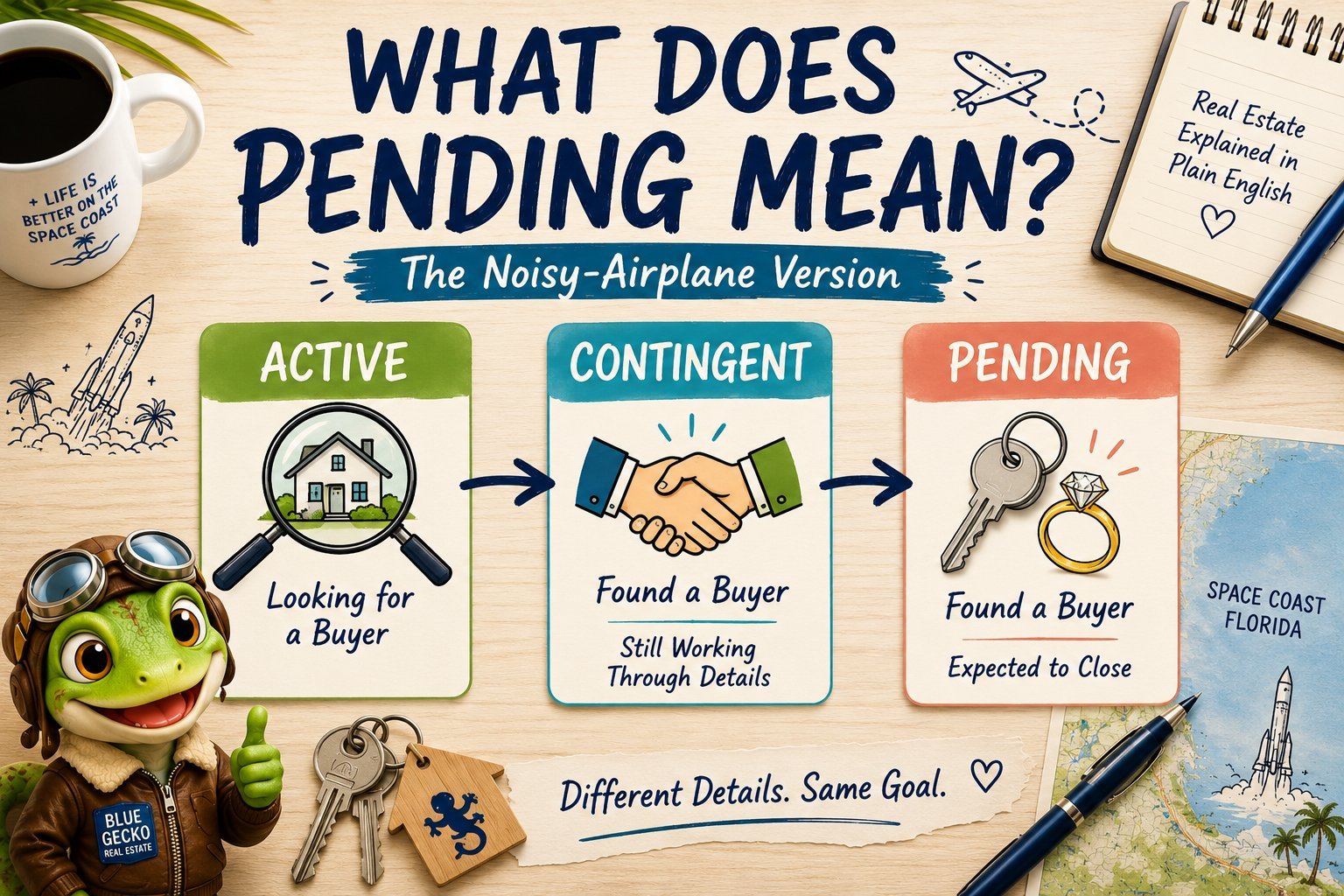
What Does Pending Mean in Real Estate?
The Noisy-Airplane Version
Pending means the seller expects to close with the buyer they already have.
Think of a home’s MLS status as the seller’s relationship status:
- Active = Looking for a buyer
- Contingent = Found a buyer, but still keeping options open
- Pending = Found a buyer. The deal isn’t done yet, but the odds are good it’s going to close
Quick Reference
| Status | What It Means |
|---|---|
| Active | Looking for a buyer |
| Contingent | Offer accepted, conditions still being resolved |
| Pending | Offer accepted and expected to close |
| Sold | Ownership has transferred |
So What Does Pending Actually Mean?
A pending home has basically chosen its dance partner.
The buyer and seller are headed toward closing together, and both sides are making plans as if the deal is going to happen.
The house isn’t officially sold yet. Nobody has exchanged keys. Nobody has celebrated with pizza on the living room floor.
But if this were a season finale, we’d be well past the “Will they or won’t they?” episode.
Active vs. Contingent vs. Pending
Active
The house is still taking applications.
Showings are happening. Offers are welcome. The seller is waiting for the right buyer to walk through the front door.
This is the real estate equivalent of a dating profile that says:
“Love long walks on the beach, vaulted ceilings, and someone who appreciates a good floor plan.”
Contingent
The seller has picked a favorite.
Now everyone is figuring out whether the relationship can survive a home inspection, an appraisal, and a lender asking for the same bank statement for the third time.
Common contingencies include:
- Home inspections
- Financing approval
- Appraisal review
- Sale of the buyer’s current home
At this stage, the seller may still be willing to entertain backup offers.
In other words, they’re dating someone, but they haven’t deleted the apps yet.
Pending
The awkward first-date phase is over.
The inspection has usually happened.
The appraisal has had its say.
The lender has mostly stopped asking questions.
Nobody is celebrating quite yet, but people have started discussing moving trucks, paint colors, and where the couch is going to fit.
If Contingent is dating, Pending is the engagement announcement.
The wedding hasn’t happened yet, but everyone is pretty sure they’re ordering cake.
Could something still go wrong?
Of course.
But most people expect cake.
Can a Pending Home Fall Through?
Yep.
Not often, but it happens.
Real estate transactions involve buyers, sellers, lenders, inspectors, title companies, insurance agents, contractors, moving companies, and occasionally a relative who decides now is the perfect time to send gift money for a down payment.
That’s a lot of moving parts.
Most pending homes close successfully.
But every now and then, a deal regenerates unexpectedly and comes back to life.
(Yes, that was a Doctor Who reference.)
Can You Make an Offer on a Pending Home?
Sometimes.
Some sellers will accept backup offers in case the current contract falls apart.
Think of it as politely standing off to the side and saying:
“If this deal unexpectedly turns into a season cliffhanger, I’d like to be considered for the next episode.”
It’s not the most glamorous strategy, but I’ve seen it work.
Frequently Asked Questions About Pending Homes
How Long Does a House Stay Pending?
Usually a few weeks.
Some transactions glide through closing like they’ve rehearsed it.
Others develop plot twists.
Is Pending the Same as Sold?
No.
Pending means everyone expects to close.
Sold means the paperwork is signed, the money has moved, and somebody is desperately trying to remember which box contains the coffee maker.
Is Pending Better Than Contingent?
Generally, yes.
A pending status usually means fewer obstacles remain between the buyer and the closing table.
Should I Keep Watching a Pending Home?
Absolutely.
I’ve seen buyers cross a house off their list only to watch it come back on the market a week later.
Real estate occasionally enjoys a surprise sequel.
Lucky’s Take
When buyers ask me about MLS statuses, I don’t really think about the technical definitions.
I think about what the seller is trying to tell us.
- An Active seller is looking for a buyer.
- A Contingent seller has a buyer, but it isn’t a done deal yet.
- A Pending seller believes they have found their buyer and expects to close.
In today’s buyer-friendly market, a Contingent listing can sometimes be a sign that the seller isn’t completely comfortable yet. They’re moving forward, but they’re also keeping a cautious eye on how inspections, financing, and negotiations play out.
Pending feels different.
By the time a home reaches Pending status, inspections are often complete, appraisal concerns may already be resolved, and both sides have mentally started planning moving day.
Could it still fall apart?
Sure.
But most Pending buyers have already started measuring walls for furniture and deciding where the Christmas tree is going.
The sellers, meanwhile, are booking moving trucks, collecting cardboard boxes, scheduling donation pickups, and mentally saying goodbye to the house they’ve called home.
The wedding hasn’t happened yet, but both sides are acting like the date is set.
And when one of my clients reaches Pending status?
That’s usually when I tell them to stop doom-scrolling Zillow at midnight and start deciding where the Christmas tree is going.
What Is a “Noisy-Airplane Version?”
One of the things we do at Blue Gecko is explain real estate in plain English.
The Noisy-Airplane Version is our test:
If I had 30 seconds to explain this topic to you on a noisy airplane, what would I say?
No jargon.
No industry buzzwords.
Just the answer you actually need.
If you want the deeper explanation, keep reading. If you’re in a hurry, the Noisy-Airplane Version gets you the important part first.
About the Author